
- Analyse legal issues arising in international business activities, including cross-border trade, foreign investment, and multinational business relationships.
- Evaluate the impact of legal systems, international treaties, and national regulations on business strategy and executive decision-making.
- Analyse, draft, and evaluate international commercial contracts, investment agreements, and legal risk allocation mechanisms.
- Propose and assess legal risk management solutions, corporate compliance frameworks, and legal governance in global business environments.
- Analyse international dispute resolution mechanisms, including commercial arbitration and alternative dispute resolution methods.
- Evaluate compliance with ethical principles, professional standards, and corporate legal responsibilities in international contexts.
- Apply legal reasoning and case-based analysis to support strategic decision-making and sustainable organisational development.

Legum Magister (LL.M.) in International Business Law






UK ENIC Band
The Master qualification is aligned with FHEQ/RQF Level 7 and has been assessed by UK ENIC as comparable to Band 12 within the UK qualification framework.

Recognised in the United Kingdom
The OTHM Level 7 Diploma is regulated by Ofqual (UK Government) and recognised as equivalent to a UK Master’s Degree level.

Recognised in Switzerland
Master graduates from SIMI Swiss can work in Switzerland immediately, as managerial roles are considered non-regulated occupations.

National Occupational Standards
Legum Magister (LL.M.) in International Business Law Dual Qualification aligned with the Senior Leader framework — leading to Senior Leader status with a UK median salary of £84,240 per year.

Recognised internationally
Recognised under UK FHEQ/RQF Level 7, the Legum Magister (LL.M.) in International Business Law Dual Qualification is accepted as equivalent to a Master’s Degree in over 180 countries and territories.

Quickly Learn a New Major
With its unique structure combining a UK-recognised qualification and Swiss private higher-education excellence, learners can switch majors quickly without starting over.
Master of Advanced Studies (MAS) – the gold standard of Swiss professional education
The Master of Advanced Studies (MAS) is a postgraduate programme characteristic of Switzerland, representing an educational philosophy that emphasises practical competence, managerial capability, and application in real professional environments. MAS programmes are specifically designed for individuals who already hold a bachelor’s degree and professional experience, aiming to enhance advanced-level competencies rather than provide purely academic training. The Legum Magister (LL.M) is a specialised law programme within the Swiss MAS framework.
Within the Swiss education system, MAS is a distinctive postgraduate education model implemented under the Swiss Qualifications Framework (SQF) and organised according to the European Credit Transfer and Accumulation System (ECTS), with a minimum study load of 60 ECTS credits. This structure ensures the academic rigour, depth, and professional quality of the programme.
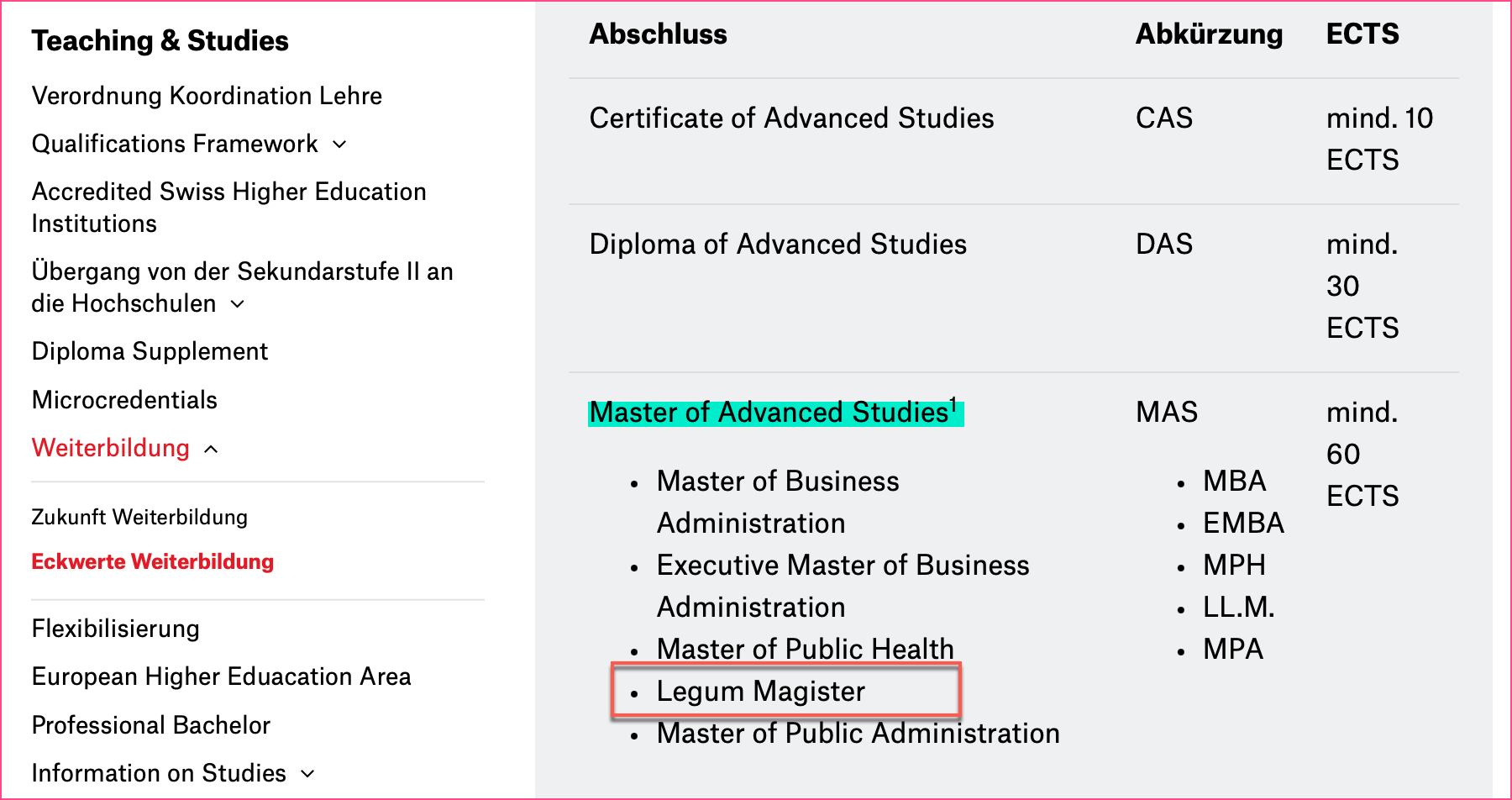
Source: swissuniversities
Higher tuition fees and selective admission requirements
Compared to traditional academic Master’s programmes (MSc, MA, etc.) offered by Swiss public universities, MAS programmes generally have significantly higher tuition fees. While traditional Master’s tuition fees typically range from approximately CHF 1,000–3,000 per year, MAS programmes at the same institutions commonly range between CHF 18,000–30,000 per year. This difference reflects the true nature of MAS: an advanced professional programme designed for working professionals, not subsidised in the same way as academic education and structured according to high professional standards.
In addition to tuition fees, MAS admission requirements are clearly selective. Beyond holding a university degree, applicants are usually required to demonstrate relevant professional experience, as MAS programmes are not built upon purely academic theory but instead develop higher-level competencies based on existing professional experience. This is a key factor contributing to the value and reputation of MAS among professionals and managers.
MAS does not distinguish between public and private institutions
In its early stages, MAS programmes were primarily offered by Swiss federal public universities. As the higher education system evolved and demand for advanced professional education increased, the MAS model gradually expanded to include private higher education institutions.
From both legal and academic perspectives, MAS qualifications do not differ based on the type of awarding institution. Whether delivered by a public university or a private higher education institution, MAS retains equivalent value and characteristics, including the following core features:
- MAS is practice-oriented and competence-focused, rather than academically research-oriented.
- MAS belongs to the category of further education and continuing professional education, distinct from academic Master’s programmes structured under the Bologna cycle.
- The value of MAS is primarily recognized within corporate environments and the labour market, including when awarded by public universities.
- MAS is not an academic degree within the academic education system (BMD system) and does not automatically grant eligibility for academic PhD studies. Progression to a PhD depends on individual university admission policies and academic decisions, based on the evaluation of the applicant’s competencies, experience, and academic achievements.
- MAS provides a clear advantage for progression into professional or practice-oriented doctoral programmes, subject to the autonomous admission principles of higher education institutions in Switzerland.
Legum Magister (LL.M) within MAS is not within the scope of Swiss ENIC evaluation, regardless of whether it is awarded by a public or private institution
Swiss ENIC does not evaluate MAS qualifications, regardless of whether the degree is awarded by a public university or a private higher education institution in Switzerland, and regardless of whether the programme is subject to Swiss domestic accreditation or international accreditation. This is not related to the nature or value of the Legum Magister (LL.M) itself, but rather because there are no equivalent comparison criteria within national or international qualification frameworks for professionally oriented advanced study programmes.
The absence of Swiss ENIC evaluation allows the Legum Magister (LL.M) to focus fully on practical competence and applied professional value in real working environments, rather than being constrained by rigid academic criteria that may not accurately reflect the needs of professional practice.
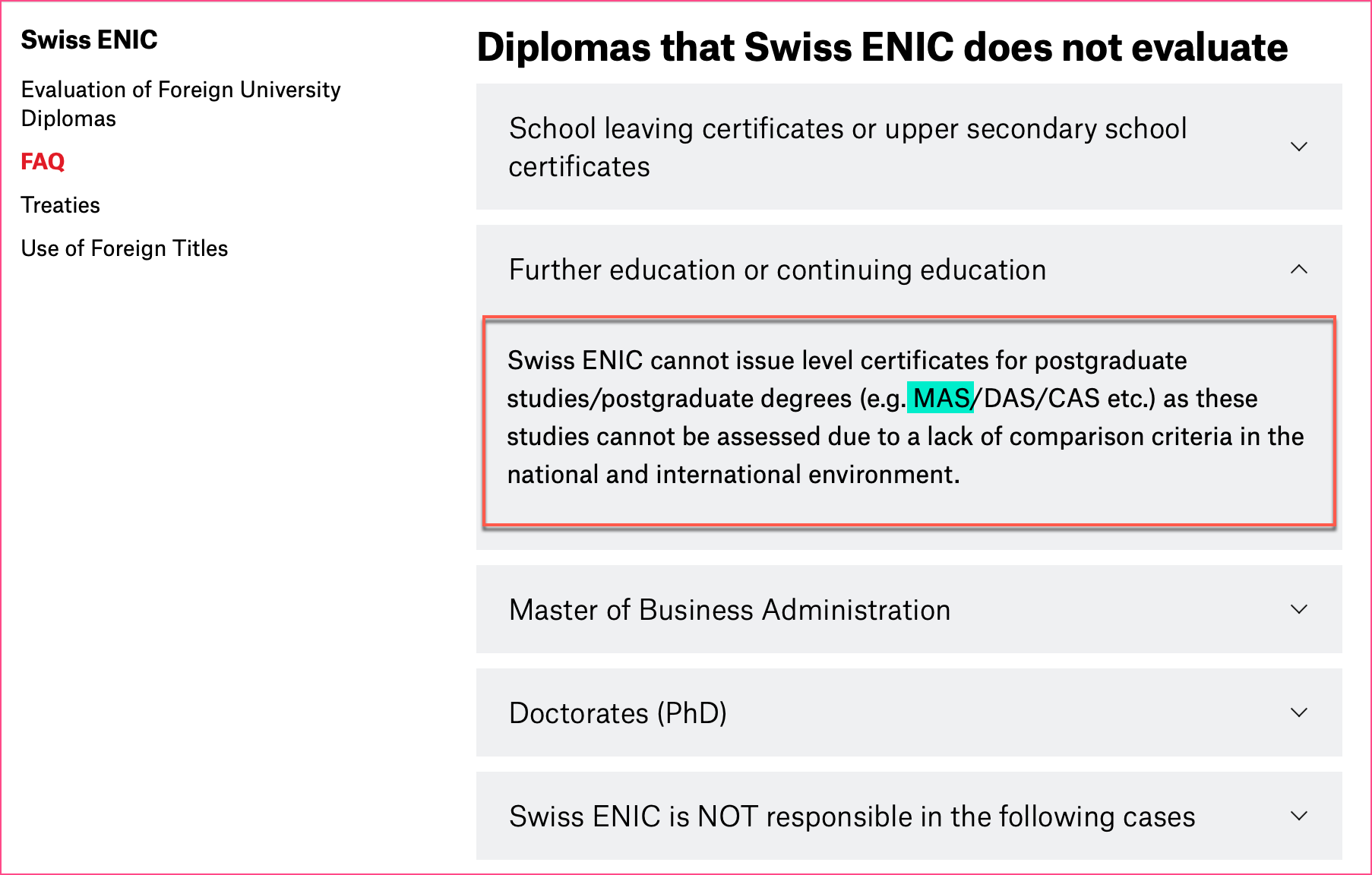 Source: Swiss ENIC
SwissUK™ – elevating the Legum Magister (LL.M) to international standards without altering its nature
The Master of Advanced Studies (MAS) is regarded as the gold standard of professionally oriented education in Switzerland, where practical competence and managerial capability are placed at the forefront. Because of its strong focus on professional application, the Legum Magister (LL.M) within the MAS framework remains a professionally oriented qualification rather than an academic master’s degree, and it does not fall under the Bologna system. As a result, there is no single unified international reference framework for presenting competencies in a global context. This is also why the Legum Magister (LL.M) is not within the evaluation scope of Swiss ENIC, regardless of whether it is awarded by a public or private institution in Switzerland.
SwissUK™ was designed to directly address this gap. Through the SwissUK™ model, learners pursuing the Legum Magister (LL.M) follow the Swiss professional education orientation while also integrating alignment with the United Kingdom’s Regulated Qualifications Framework (RQF). This allows academic and professional competencies to be positioned within a widely recognised international framework, making them easier to present to employers, multinational organisations, and professional bodies worldwide.
More importantly, SwissUK™ preserves the core value of the Legum Magister (LL.M) as a gold-standard Swiss applied professional qualification. It does not change its legal nature or transform the LL.M into an academic master’s degree. Instead, the model maintains the Swiss identity of the Legum Magister (LL.M) while adding an additional international explanatory layer, making academic and professional profiles more transparent, comparable, and credible in a global environment.
The programme awards two qualifications:
- Level 7 Diploma in International Business Law – awarded by OTHM (United Kingdom)
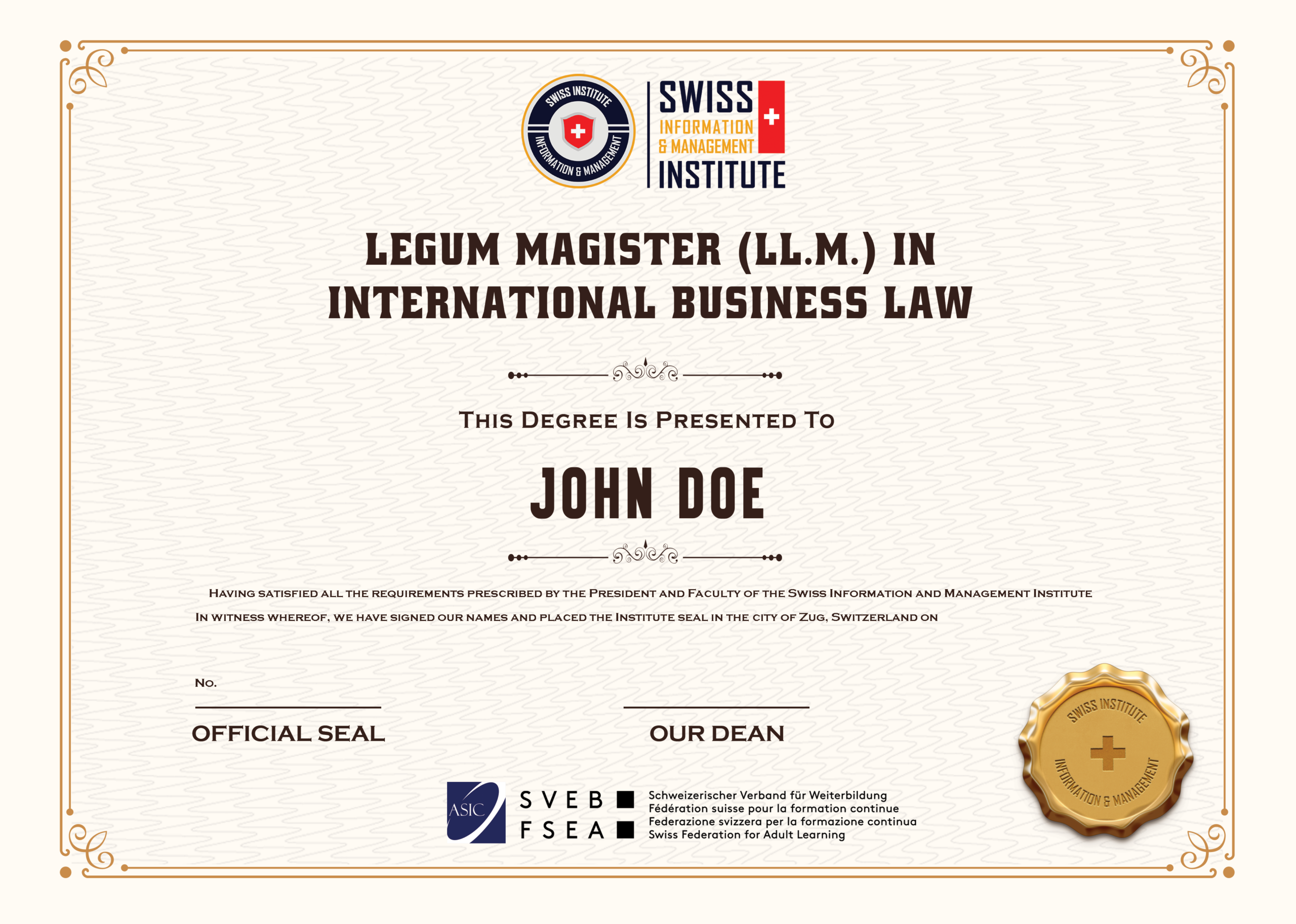
- Legum Magister (LL.M.) in International Business Law – awarded by SIMI Swiss (Switzerland)
These two qualifications are fully integrated, creating maximum strength and value for graduates upon completion.
Yes.
- The OTHM qualification is regulated by Ofqual (UK Government), ensuring national standards of quality, transparency, and compliance in the United Kingdom.
- SIMI Swiss is an international higher education institute operating under the Swiss Private HEI model, registered and governed in the Canton of Zug. It is responsible for the academic value of its Private Degree programmes in accordance with Swiss law.
The UK Qualification Reference Statement issued by an authorised representative of the UK Department for Education is the highest-level document confirming the status of a graduate’s qualification, serving to authenticate and recognise:
- Verification that the qualification is recognised in the United Kingdom.
- Recognition of the qualification’s level and position within the UK national qualification frameworks, including all three frameworks:
- The Regulated Qualifications Framework of England, Wales, and Northern Ireland (RQF)
- The Scottish Credit and Qualifications Framework (SCQF)
- The Credit and Qualifications Framework for Wales (CQFW)
Example: A qualification recognised by the UK Department for Education with the notation UK Framework Levels – RQF Level 7 / SCQF Level 11 / CQFW Level 7 means that the qualification is classified at the MASTER’S level across the entire United Kingdom and holds academic validity in England, Scotland, Wales, and Northern Ireland.
- Confirmation that the awarding institution is recognised by the UK Government.
- Confirmation of the entry requirements for obtaining the qualification.
- Confirmation of the assessment and examination procedures.
- Confirmation of the graduate’s competency and employability.
- Confirmation of progression opportunities for further study within the UK National Education System after completing the qualification.
Yes.
The SwissUK degree awarded by SIMI is recognised for employment in Switzerland without any additional procedures, as positions within the Business and Management group fall under non-regulated occupations that do not require a professional licence.
The Governments of Switzerland and the United Kingdom have signed a Mutual Recognition Agreement on Professional Qualifications, effective from 01/01/2025. Under this agreement, professional qualifications issued in either country may be submitted for recognition when applying for a professional licence in the other country, including professions that fall under the professionally regulated category—those requiring a licence to practise.
As a result, qualifications within the SwissUK™ education system—particularly programmes awarded by Ofqual Awarding Bodies—are eligible to be submitted as part of the initial application for recognition or for obtaining a new professional licence in Switzerland, in accordance with the mechanisms defined in the agreement.
References:
- Swiss–UK Mutual Recognition Agreement on Professional Qualifications from the UK Government: HERE
- Swiss–UK Mutual Recognition Agreement on Professional Qualifications from the Swiss Government: HERE
- List of approximately 200 regulated professions requiring a professional licence under the Swiss–UK Mutual Recognition Agreement (qualifications within the SwissUK™ system—including those from Ofqual Awarding Bodies—are eligible for initial assessment according to the agreement): HERE
UK ENIC benchmarks RQF Level 7 at Band 12, which is equivalent to a Master’s Level. See more details HERE
Yes.
According to the European Qualifications Framework (EQF), RQF Level 7 is aligned with EQF Level 7. See more details HERE
Yes. It may be evaluated as equivalent to a Master’s degree or Master-level, depending on the individual application, through:
- CICIC (Canada)
- WES (USA/Canada)
The final outcome depends on the purpose of the evaluation and the independent assessment conducted by these agencies. See more details HERE
Yes.
The qualification integrates the competency standards for the Senior leader – Occupational Code OCC0480 under the UK occupational framework. See more details HERE
According to labor market data from the United Kingdom, the average annual salary for the Business and administration group (which includes manager roles aligned with this programme) is £84,240 per year. See more details HERE
Yes.
According to the Statement of Changes to the UK Immigration Rules (effective 2025), the minimum qualification level for the Skilled Worker Visa has been raised to RQF Level 6.
A qualification at RQF Level 7 exceeds the mandatory academic requirement.
- See more details HERE
Yes. Learners are eligible to apply for postgraduate programs such as:
- Doctor of Business Administration (DBA)
- Doctor of Management / Doctor of Leadership
- PhD in Law, Business Law, International Trade Law, Commercial Law, International Business, or related disciplines.
Reference: Recognition of RQF/EQF Level 7 as a Master’s degree under international education standards. See more details: HERE
All qualification recognitions, top-ups, or transfers under the Swiss and UK education systems are subject to the specific policies of the receiving institution or relevant authority — verification should be conducted in advance where applicable.
Yes.
- SIMI Swiss provides consular legalization services for its qualifications. See more HERE.
- OTHM offers an online qualification verification system via QR Code. See more HERE.
- The UK Department for Education confirms that OTHM qualifications (including those bearing the SIMI name) are officially recognised by the UK Government and mapped to RQF Level 7 / SCQF Level 11 / CQFW Level 7 (PGD/Master Level).
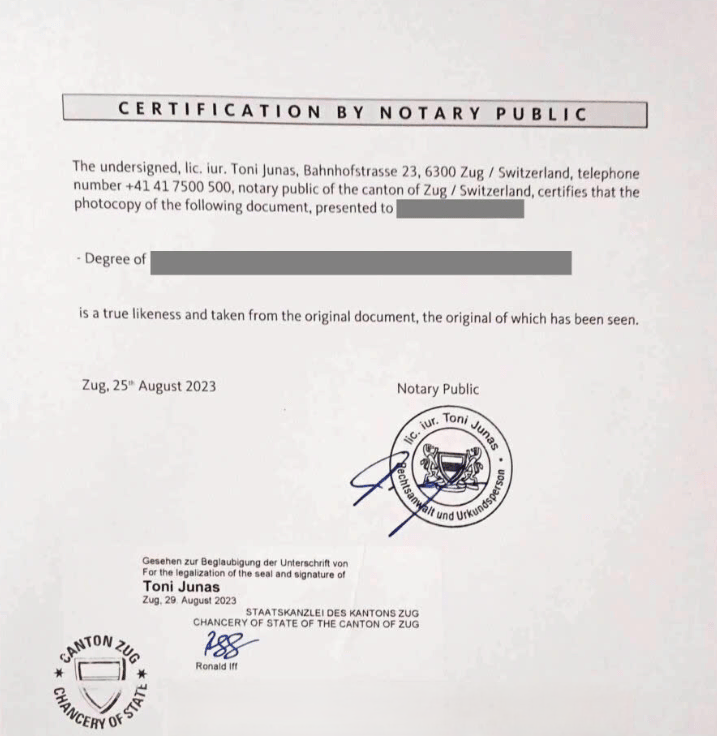
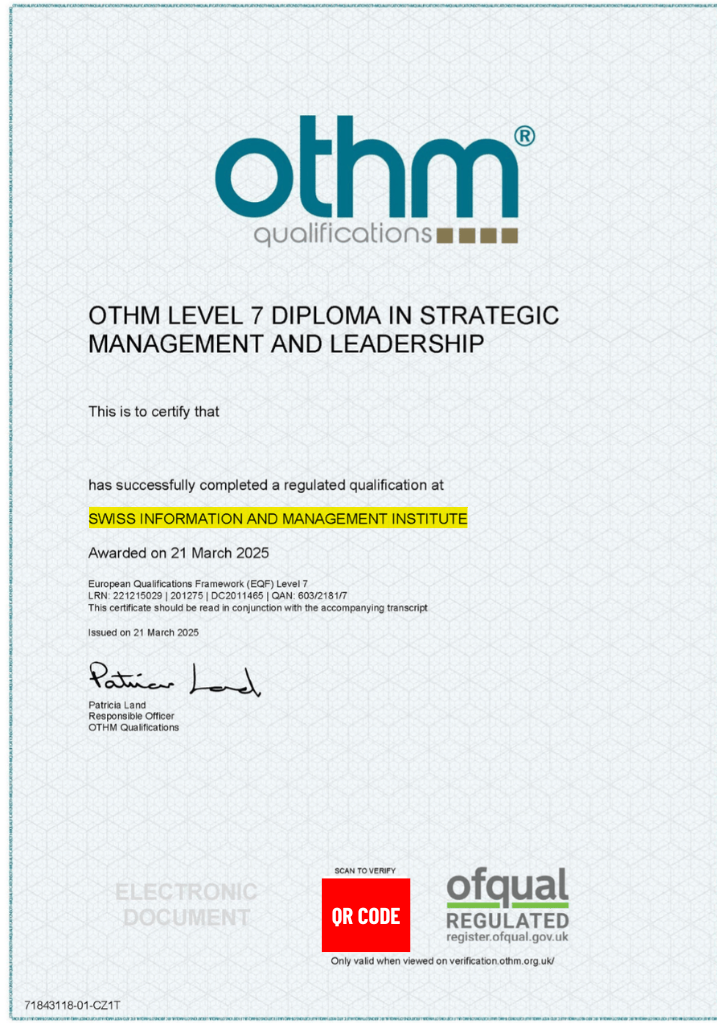
Information relating to the programme, the qualification, its accreditation status, and any associated recognition frameworks is derived from official publications issued by the UK Government, statutory regulatory authorities, and other competent bodies. All information is accurate as of the date of publication; however, it may be amended, revised, or withdrawn at any time without prior notice, pursuant to updates in applicable policies, regulations, or statutory instruments.
Although recognition, cross-recognition, and equivalency frameworks are established on transparent, objective, and verifiable criteria, each country, ministry, governmental department, professional body, or receiving institution retains sole discretion and full adjudicatory authority to determine whether a qualification is recognised, accepted, or deemed equivalent under its internal regulations and legal jurisdiction. Accordingly, learners bear full responsibility for verifying recognition requirements directly with the relevant authority or institution before relying on the qualification for any legal, academic, or professional purpose.
In accordance with principles of transparency and jurisdictional compliance, SIMI Swiss, UKeU®, OTHM, and all related parties do not make any commitment or representation regarding qualification recognition, equivalency, immigration status, or professional licensing in any country, ministry, department, or regulatory body.
This information is provided to ensure accuracy and transparency in public communication, consistent with international standards and best practices in academic disclosure.